

Energetic Hygiene for Human Design Practitioners

Updated: Aug 1
Journey Human Design | Human Design for Practitioners

What happens after a session ends is rarely given the same attention as what happens within it. The preparation before, the quality of presence during, and the tools and attunement that shape the hour receive considerable thought. The transition out, the period between one client and the next, tends to receive far less, along with the question of what has been absorbed and what needs to be released before the next person arrives.
For practitioners working with an understanding of Human Design, that transition becomes something more specific than a general decompression practice. It becomes a moment of discernment, a brief but deliberate return to one's own design, a recognition of what moved through the session and what, if any of it, is still present in the field.
The Session as an Energetic Exchange
Every session between a practitioner and a client is, at an energetic level, an exchange between two designed systems. The practitioner brings their aura, defined centers broadcasting consistently, open centers receiving and amplifying whatever the client carries. The client brings theirs. Together they form a temporary shared field, and what moves through that field during the session does not automatically clear when the session ends.
This is a mechanical claim more than a metaphysical one.
When a practitioner with an undefined Emotional center sits with a client whose Solar Plexus is defined and moving through an intense part of their wave, the practitioner absorbs and amplifies that emotional frequency throughout the session. When the session ends, the amplified emotion does not disappear because the client has left the room. It lingers in the practitioner's field, sometimes for minutes, sometimes considerably longer, and without awareness of its origin, it can be easily misidentified as the practitioner's own emotional state.
The same applies across every undefined center, though it shows up differently depending on which center is open. An undefined Head tends to pick up the mental pressure of clients arriving with active, churning thought, leaving the practitioner with a looping quality of thought that was never theirs to begin with. When the Root is open, the adrenal pressure of a client in a state of urgency or stress can carry over, showing up as a practitioner who feels rushed or struggles to settle once the session has ended. And an undefined Sacral picks up the generative energy of Generator clients directly, often producing a burst of unusual engagement during the session followed by a noticeable drop once the client is gone.
None of this is harmful by itself. The sensitivity that comes with open centers produces a real quality of attunement and perception that serves the work. The difficulty arises when the absorbed energy goes unrecognized, and the practitioner carries what accumulated in one session into the field of the next.
The Question That Orients the Transition
The simplest tool for the transition between sessions, and one of the most practically effective, is a single question held briefly after the client has left: what felt like me, and what felt like theirs?
This question calls for a brief, honest check rather than an analytical exercise, a moment of returning to the practitioner's own baseline and noticing what, if anything, feels different from it. Emotion that arrived during the session and has not quite settled. A quality of pressure or urgency that does not match the practitioner's usual state. A mental loop that began somewhere in the middle of the session and continued after. A heaviness or a restlessness may be information about what was absorbed rather than what is actually present.
When something is recognized as absorbed rather than originating, the release tends to happen more quickly. A quality of lightening comes from the recognition itself, a shift from "this is how I feel" to "this is what I am still carrying from that session," that changes the relationship to the experience without requiring any particular technique to address it.
Knowing Which Centers to Watch
For practitioners who know their own Human Design chart, the transition becomes more precise. The undefined centers are the specific places where absorption happens, and knowing which centers are open gives the practitioner a map of where to direct their attention in the moments after a session.
A practitioner with an undefined Solar Plexus can expect emotional intensity during a session to have been amplified from the client's field, and can hold post-session emotional material with a degree of neutrality, neither dismissing it nor identifying with it as their own truth.
For an undefined Heart Center, post-session pressure around achievement or worth, the sense that the session should have gone differently or that more should have been offered, is more likely to be absorbed pressure than an accurate signal about the quality of the work. And an undefined Spleen may carry lingering anxiety or unease from a session with a client whose Spleen is defined and activated, unease that belongs to the client's field rather than pointing to anything the practitioner needs to attend to.
This is a tool for discernment, not a framework for dismissing everything uncomfortable as "not mine." Some of what arises after a session is real, a genuine response to something that happened, a signal worth attending to, a piece of information about the dynamics that were present. Learning to tell the two apart is precisely the skill this awareness is designed to develop, and it deepens with practice rather than arriving complete.
Practical Approaches to Clearing Between Sessions
Movement tends to be one of the most effective ways to shift what has been absorbed, a short walk, a change of environment, any physical engagement that interrupts the continuation of the session's energetic quality into the next period of time. The body tends to process absorbed energy more efficiently when it is moving than when it is still.
Silence matters just as much.
The period between sessions that fills up with calls, messages, background noise, or the continuous input of a screen leaves absorbed energy nowhere to discharge. A period of real quiet, even five or ten minutes, creates the conditions in which the practitioner's own baseline can reassert itself, and in which what belongs to the session can begin to settle back to the people it came from.
For practitioners with an undefined Sacral, Projectors, Manifestors, and Reflectors, rest between sessions is not optional or indulgent. The undefined Sacral does not have the Generator's capacity to regenerate overnight and resume at full capacity the following morning. It requires real rest, periods of disengagement from the energetic field of others, to return to its own baseline. Scheduling sessions with gaps rather than back-to-back tends to make a material difference to the quality of presence the practitioner can sustain across a working day.
The Practitioner's Own Design as the Ground
What Human Design ultimately offers the practitioner is a clearer understanding of what their own baseline actually is, more than a set of hygiene practices to add to an existing routine. It shows what their energy feels like when it is theirs, how their defined centers tend to broadcast, what their open centers are most likely to have absorbed in a given session, and what returning to themselves means in specific, practical terms rather than as a general aspiration.
That clarity becomes the ground from which each new session begins. A practitioner who knows their own design with some depth can recognize, more quickly and more precisely, when they are operating from their own center and when they have drifted, giving them a more reliable internal compass for the quality of their own presence than any external framework alone can provide.
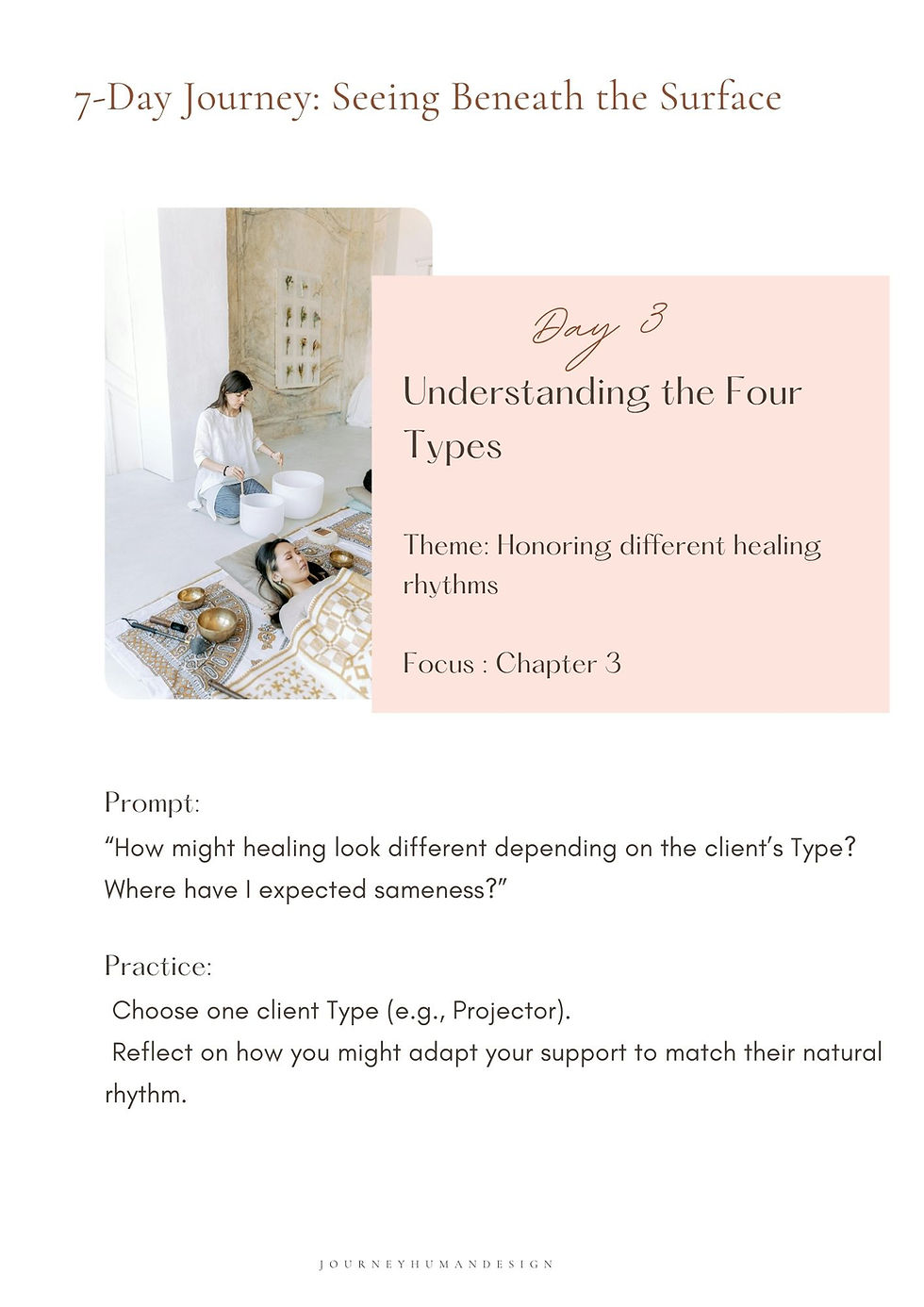
Seeing Beneath the Surface explores each of the four Types in depth, alongside the practitioner's own design, the dynamics that arise between two charts in a session, and the ethical dimensions of bringing Human Design into client work.

A companion Practitioner Toolkit is included for session preparation and reflection, with pages like the Client Energetic Profile Sheet above, built to help you track a client's Type, Authority, and centers so patterns are easier to spot across sessions.

Comments