

Human Design For Sensitive People

Updated: Sep 9

For years I mistook my own sensitivity for a flaw. I could walk into a room and within minutes feel as though I were carrying something that had not been mine when I arrived. Certain environments drained me completely while others left me unexpectedly restored, and I had no framework for why.
I had explored astrology and read widely in psychology. Each offered something useful, but none quite explained the mechanics of it: why certain decisions felt immediately clear while others left me circling for weeks, why my energy seemed to shift depending on who was in the room.
Human Design was the first system that gave that experience a coherent structure. Not a label or a personality category, it is closer to a map of how energy moves through a body, and why it moves differently through different people.
How the Bodygraph Works
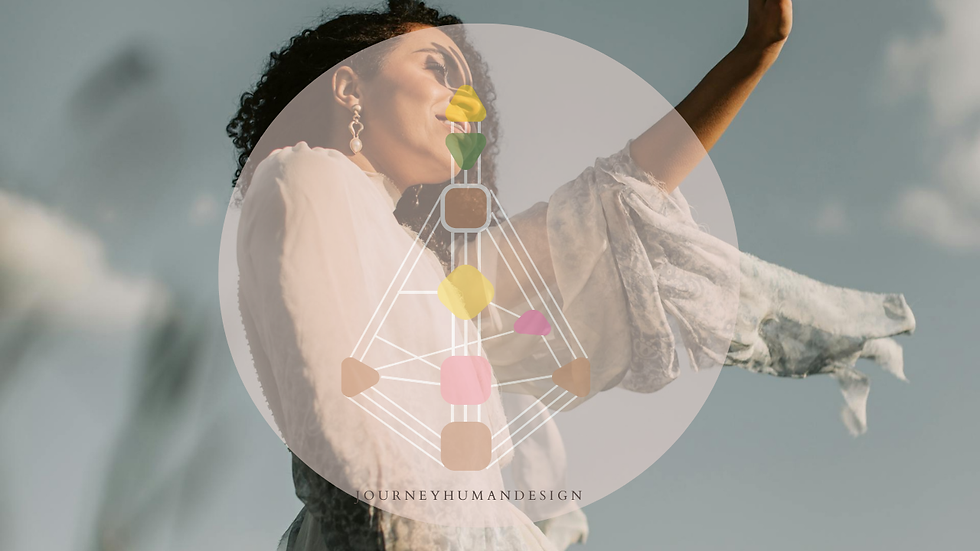
Human Design synthesizes elements of the I Ching, the Kabbalah, the Hindu-Brahmin chakra system, and Western astrology into a single framework. Using birth date, time, and place, it generates a BodyGraph, a visual map of nine energy centers and the channels that connect them.
Some centers in the graph are defined, meaning they operate consistently and reliably in a person's energy field. Others are undefined, open to receiving and amplifying the energy of those around them. This distinction explains a great deal about why sensitive people tend to feel so much: the undefined centers take in the world deeply, and without awareness of that process, it can be difficult to know where your own experience ends and someone else's begins.
The system describes four energy Types, Generators, Manifestors, Projectors, and Reflectors, each with its own Strategy for moving through the world in a way that fits how their energy functions. Strategy is not a prescription. It describes the path of least resistance, the way that tends to work when everything else is stripped away.

Four Types and How They Navigate
Understanding Type is often the most clarifying entry point into Human Design, particularly for people who have spent years wondering why conventional advice about productivity, decision-making, or relationships has never quite fit.
Manifestors make up a small minority of the population, commonly cited around 8% within Human Design teaching. They are the only Type with initiating energy, the capacity to begin things from a place of internal impulse without waiting. Their Strategy is to inform: to let those affected by their actions know what is coming, so resistance does not build around them. Manifestors who have spent their lives being told to slow down, consult more, or justify their impulses often carry a particular exhaustion with that friction.
Generators and Manifesting Generators are the same energy Type, with variations in how that energy expresses itself, and together they make up the majority of the population. Both have a defined Sacral center. The response is immediate and expressed through sound, arriving in the moment of contact rather than through analysis. The Sacral is not a mental resource; it responds rather than reasons.
For Generators who have spent years being taught to think their way through decisions, learning to trust that body response can feel foreign at first, and clarifying over time. The variation between the two lies in how that Sacral energy moves, steadily and sequentially for Generators, more multi-directionally for Manifesting Generators, though the source and Strategy are the same: remain open to what life brings, and notice whether the Sacral responds.
Projectors make up around 20% of the population, per Human Design teaching figures. They do not have consistent access to the same kind of life force energy as Generators. They are built to guide, to see systems and people clearly, and to offer that perception when it is invited. The Projector Strategy is to wait for recognition and invitation before offering guidance or entering into significant new commitments.
Without that recognition, the same insight that would land well in the right context can be met with indifference or resistance. Many Projectors arrive at Human Design after years of feeling overlooked, or of giving their energy to places and people that never quite received it.
Reflectors are the rarest Type, cited at roughly 1% of the population. They have no defined centers; their entire chart is open, which means they are exquisitely sensitive to the people and environments around them. Reflectors sample the energy field rather than holding any consistent definition of their own. Their decision-making Strategy involves waiting a full lunar cycle before committing to significant choices, allowing enough time to experience a decision across many different energetic contexts before settling into clarity.
Strategy as a Return to Your Nature
One of the things that drew me to Human Design, and that I return to when the system starts to feel overly complex, is the simplicity underneath all of it: each Type has a Strategy, and that Strategy describes how a person tends to move most naturally once conditioning has settled enough to let the original rhythm through.
Conditioning, in Human Design, refers to the gradual accumulation of patterns and beliefs absorbed from family, culture, and environment, the slow layering of ways a person learns to operate according to what is expected of them. Deconditioning is the slow process of returning to a more original rhythm, and Strategy is one of the most direct ways to begin that return.
For someone who has always felt everything deeply, discovering that their sensitivity is a design feature, that the undefined centers are places of wisdom and receptivity, tends to land as real relief. Something that had felt like a burden begins to make sense in a different way. The exhaustion had a source, and that source can change over time.
Authority: The Other Half of the Navigation
Alongside the Strategy, Human Design describes Authority: the specific inner resource each person is built to use when making decisions. For most people, this lives outside the mind. The mental analysis most people have been taught to rely on is, in Human Design, considered one of the least reliable places to make significant choices from.
Authority tends to live in the body. Emotional Authority, the most common, involves waiting through an emotional wave before deciding, letting clarity settle rather than forcing resolution in the middle of a feeling.
Sacral Authority, present in Generators and Manifesting Generators, is the gut response that can be trusted for its consistency and its reliability across situations. Splenic Authority is the fast, present-tense knowing of the Spleen center, quicker than the Sacral, and easily talked out of by the mind.
The experiment of Human Design, at its most practical, is this: try following your Strategy and Authority for decisions, and notice what changes. Not all at once, and not expecting immediate revelation, but gradually, with the patience real deconditioning requires.
If you are new to Human Design and want a clear introduction to the whole system, the Types, Centres, Authorities, and what the experiment involves, the free Beginner's Guide on this site is a good place to begin.
If you are ready to explore further, the Journey Human Design shop holds resources for different types and stages of the experiment, including type-specific guides and tools for daily practice. Everything there supports the move from studying the system to living it. For a guided reading, Sessions are also available to book.


Comments