

The Role of Undefined Centers in Human Design

Updated: Sep 9

At some point, most people on a self-discovery path have encountered this: someone else seems settled in a way you are not. They do not seem to second-guess as much. They make decisions and move on. You find yourself wondering if you are missing something they have, some internal steadiness that never quite arrived for you.
I spent years in that particular loop. I could take in almost any perspective and find something valid in it. I could feel the energy of a room shift the moment I walked in. I was extraordinarily aware of how others were feeling, sometimes more aware of their experience than my own. None of this felt like a gift at the time. For a long time, it felt like too much, like evidence of a self that was somehow incomplete.
Human Design offered a different interpretation, a structure, a way of understanding what was happening in those moments, and why.
The Chart Distinguishes Between Defined and Open
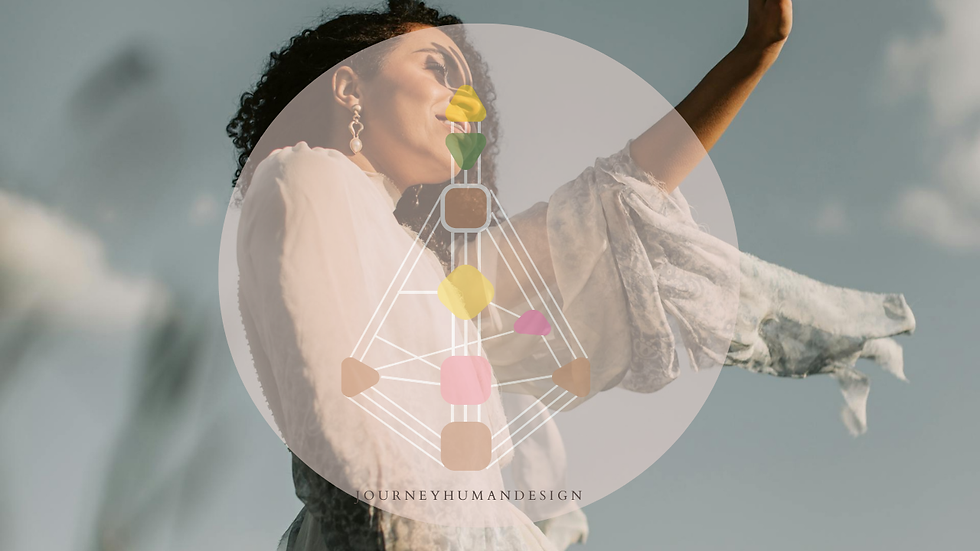
In a Human Design chart, the nine energy centers can be either defined (coloured in) or undefined (white). Defined centers carry consistent, reliable energy. They function in a stable, recognizable way regardless of context or company. Open centers, also called undefined centers, work differently.

An open center receives, amplifies, and reflects the energy of whatever is present in its environment, including the defined centers of the people around you. When someone with a defined Sacral center (the center associated with life-force energy and response) sits across from you, and your Sacral center is open, you may find yourself suddenly energized, driven, or productive in a way that does not quite match your usual rhythm. And when they leave, that energy leaves with them.
Open centers take in and reflect the energy present around them.
Why Open Centers Can Feel Overwhelming
The challenge with open centers is amplification. Whatever energy enters becomes intensified as it moves through the center. Someone with an open Emotional Center often experiences the feelings in a room as their own, more acutely than the person who originated them. Someone with an open Head Center may find themselves preoccupied with questions that are not theirs to answer, drawn into mental loops by the mental pressure of others around them.

Over time, this amplification leads to conditioning. The open center begins to adapt: seeking out the energy it has come to depend on, behaving in ways that attract it, or avoiding situations where that energy becomes painful. This is where patterns form that can feel deeply personal, though they are often largely environmental.
Recognising this is one of the more significant shifts in Human Design, because it offers a context that does not require self-judgment.
What Openness Can Become Over Time
Ra Uru Hu, the founder of the Human Design System, described open centers as places of wisdom. The reasoning is that because an open center receives such a wide range of energy over a lifetime, it accumulates an unusually nuanced understanding of that particular domain.
Someone with an open Will Center, the center associated with willpower, ego, and proving oneself, may spend years driven by a need to demonstrate their worth. This is the conditioned expression of that openness. The potential that lies beyond the conditioning is a deep, experiential understanding of how willpower works and where the drive to prove things originates, built slowly from lived experience.
This is true across all nine centers. Each open center holds the potential for a particular kind of awareness, one that tends to emerge through the slow accumulation of experience and the gradual loosening of conditioned patterns.
A Practical Way to Begin
If you are looking at your chart and noticing how many centers are open, it can initially feel like a long list of vulnerabilities. That is a common first response, and an understandable one. What tends to shift that perception is time and observation.
One of the most useful experiments is to begin noticing when your internal state changes depending on who you are with, or where you are, without trying to fix or manage what you notice.
Over time, a pattern becomes visible: some energy feels familiar and some feels foreign, some belongs to you and some is amplified from elsewhere. The distinction does not always arrive immediately, but it does arrive.
This kind of observation is what Human Design calls the experiment: a slow, gentle process of getting to know your own energy well enough to recognize what belongs to you and what you have been carrying for a while.
If you are new to Human Design and want a clear, grounded introduction to how the chart works, including what centers are, how defined and open energy interact, and how to begin reading your own chart, the free Beginner's Guide is a good place to start. It is written for people who are thoughtful and searching, ready to take the material seriously.
See inside → the type-specific guides, which go further into how these patterns show up in daily life for each Type.
Sessions are available to book for a closer look at your own chart.

Comments