

What to Say When Someone Asks About Human Design

Updated: Sep 9
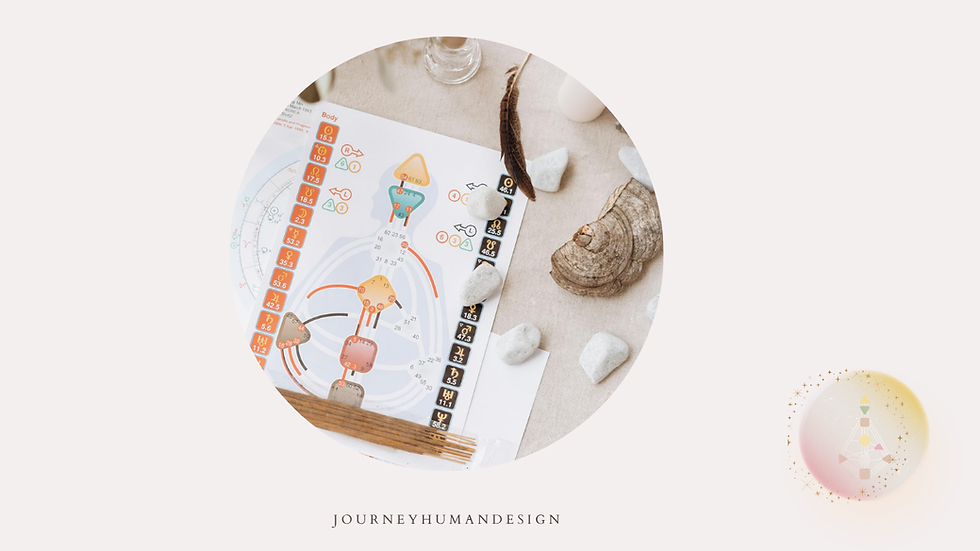
When I first discovered Human Design, I wanted to tell everyone. I would reach out and start explaining, sometimes for an hour, layering concept upon concept because it all felt so urgent and so alive to me. I had found something that made sense of things I had carried for years without language for them, and the most natural impulse was to hand it immediately to the people I loved.
It went differently than I expected. Some people listened politely and moved on. Others looked puzzled. A few pushed back before I had finished a sentence. I kept finding myself frustrated, less with them than with my own inability to translate something so clear inside me into something another person could receive.
When the Explanation Comes Before the Curiosity
Human Design doesn't announce itself easily. It draws on astrology, the I Ching, the Kabbalah, the chakra system, and quantum physics. Trying to summarize all of that in a single conversation, before anyone has expressed interest, lands as overwhelming. The complexity that makes the system rich also makes it easy to dismiss when the door is closed.
What I've come to understand is that there's a meaningful difference between sharing something and offering it. Sharing can happen in any direction, at any moment, whether or not the other person is ready. Offering requires that someone has already reached toward you, with a question, with curiosity, with some small gesture that says they want to know.
When someone asks me now what Human Design is, my answer is much shorter than it used to be. I tell them it's a system that helps you understand how your energy moves and how to make decisions from a place your body recognizes as true. If they nod and move on, that's the end of it. If they lean in and ask more, we have a real conversation.
What to Say When Someone Wants to Know
The simplest entry point I have found is this: Human Design gives you a map of your inner compass. There is a great deal of noise available at all times, from social media, news cycles, other people's opinions about who you should be. Human Design offers a way back to something more reliable. Your own body's intelligence. Your own navigation.
That framing tends to land because it speaks to something most people are already feeling, even if they would not describe it in those terms. The sense that there is too much coming from outside and too little clarity from within. Human Design addresses that through something specific and personal: your chart, your Type, your centres, your Strategy and Authority. Each of these points back to you.
From there, if someone wants to go deeper, I find it useful to share a little of the origin. Ra Uru Hu, the founder of Human Design, received this knowledge in 1987 through what he described as an extraordinary encounter, and spent the rest of his life teaching the system to those who were ready to receive it.
When Someone Is Skeptical
Skepticism is a reasonable response to a system that includes bodygraphs, channels, and planetary transits at birth. I let it stand. If someone signals early that they are closed to it, I say it is something I find deeply useful in my own life and my work, and I leave it there.
The invitation can only be received by someone already looking for what is being offered. Pushing Human Design toward a person who is uncurious about it serves neither of you. What works, in my experience, is being visibly at ease with your own life in a way that makes people curious on their own terms, in their own time.
Where This Gets Harder
The rule holds easily enough at a dinner table. It becomes slippery online, and I notice this most as a Projector, where the question of invitation is not a courtesy but the mechanics of how my energy is received.
A comment thread looks like an open door in a way a private conversation does not. Someone posts that they feel lost, that they have tried everything, that they do not know why the same patterns keep repeating. Everything in the post seems to be reaching toward exactly what I carry. It is not reaching toward me.
Visibility is not invitation. Being tagged is not invitation. A public statement of struggle is not an invitation, even when I can see precisely how I might help. The invitation is direct, personal, and asks for something specific. I have learned this slowly, and I still have to remind myself of it, usually with my hand already hovering over a reply.
A Place to Begin
If you are new to Human Design yourself, or you would like something to hand to a friend who has started asking questions, the free Beginner's Guide on this site offers a calm introduction to the whole system: the Types, the centres, Strategy and Authority, and what the experiment involves.
If you are ready to go further into your own design, the Journey Human Design shop holds type-specific guides and tools for daily practice. For a personal reading, sessions are available to book.
When you would like to explore your own chart together, Sessions are available to book.


Comments