

Human Design Gate 6, the Gate of Friction

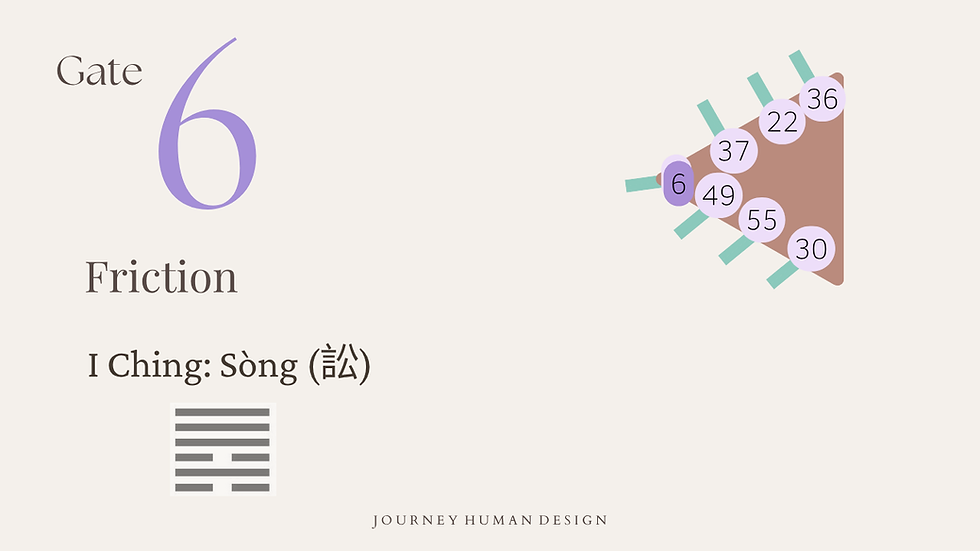
Closeness between two people rarely arrives smoothly. A new friendship may go through a tense evening before it deepens, and a couple may find that a long disagreement leaves them more intimate than they were before it started. In Human Design the friction that decides who comes close is traced to Gate 6, which sits in the Solar Plexus.
The Gate of Friction
Gate 6 is the Gate of Friction, sometimes called the Gate of Conflict. Its image comes from Hexagram 6 of the I Ching, Conflict (Sòng, 訟), heaven moving upward while water flows down, two forces pulling in different directions.
The 6 sits in the Solar Plexus, the center of emotions and the emotional wave, and belongs to the Defense circuit of Tribal circuitry. This small circuit is concerned with bonding and the continuation of the family line. The 6 works like a membrane between a person and the world around them. It opens to let someone in or closes to keep them out, and the opening and closing follow the emotional wave. Friction is how the membrane tests what comes near, and in Human Design that friction is understood as necessary, since intimacy and growth both depend on it.
Gate 6 is one of seven gates in the Solar Plexus, and each of them carries its own fear. I've written about all seven in Human Design Fears of the Solar Plexus, and about the center itself in The Emotional Center in Human Design.
6-59 Channel of Mating
Across from Gate 6 sits Gate 59 in the Sacral, the Gate of Sexuality, also called the Gate of Dispersion. Together they form the Channel of Mating, a design focused on reproduction. The 59 carries a generative pull to break down barriers and come close, and the 6 decides whether the barrier opens. This channel holds some of the most powerful bonding energy in the chart, and its reach goes beyond sexuality to every relationship where intimacy is possible, including friendships and working partnerships. Because the 6 is emotional, that decision follows the wave, and clarity about who to let in tends to come with time.
When both gates are defined, the pull toward intimacy and the friction that tests it work as one consistent theme, and people often feel this person's presence strongly. With the 6 alone, the emotional quality is present while the pull of the 59 comes through other people or through transits. In that configuration, a person may find that certain people stir up friction in them quickly, and that the friction is often the first sign of a bond forming.
Gate 6 in everyday life
Day to day, the 6 often shows up in how a person handles closeness. Someone with this gate may feel warm and open toward a new colleague on Monday and guarded with the same person by Thursday, with nothing in particular having happened in between. Their emotional wave has moved, and the membrane has moved with it. Small disagreements can flare up easily around them, and many people with the 6 come to see those moments as part of how they get to know someone.
Timing matters a great deal here. Decisions about who to let in, whether that means a new relationship or a business partnership, tend to hold up best when they are made after the wave has had time to settle. A person with the 6 who waits through a few emotional highs and lows before saying yes usually finds that the people who are still close afterwards are the ones who belong there.
The lines of Gate 6
Each line shapes how Gate 6 opens to closeness and closes to it, and the 6-line reference in my 64 Gates of Human Design Flash Cards covers every gate line by line.

If Human Design is new to you, my free Beginner's Guide is a grounded place to start. If you want to sit with the Gates in your own time, 64 Gates of Human Design Flash Cards in my shop walks through all sixty-four. When you would like to explore your own chart together, Sessions are available to book.


Comments