

The 9 Centers in Human Design

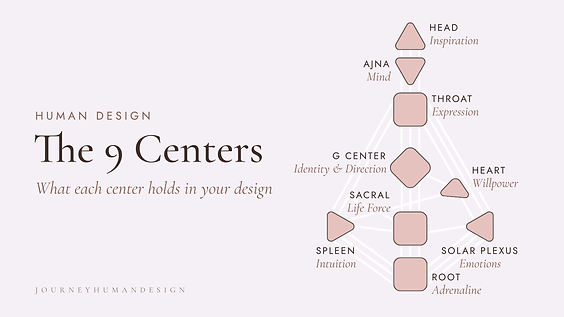
When you first open your Human Design chart, you see the outline of a human figure with nine shapes arranged inside it, joined by lines. Some of the shapes and lines are coloured in, and others remain white. This map is called the Bodygraph, and the nine shapes are the centers. Each center is tuned to its own frequency, much like a radio station, so that one picks up emotion and another the impulse to speak or act. Together they show how you take in and process energy and information, which makes them the most practical place to begin reading your chart.
What a center is
Each center is a hub of energy with its own theme, such as communication or willpower. Lines called channels run between the centers, and each channel consists of two gates, one at each end. When a channel is complete in your chart, the energy flows between the two centers it joins, and both centers become defined. Human Design teaches that the human being has carried nine centers since the late eighteenth century. Each center is understood mechanically, through how the body and mind work.
Defined and open centers

A defined center is coloured in on the chart. Its energy is consistent and reliable, and it works the same way whether you are alone or in company. This is where you have a fixed way of operating, something others can count on from you over time.
An undefined or open center remains white. Its energy is open to the people and the environment around you, and it tends to take in and amplify whatever is present. An open center is where conditioning happens most easily, because what you feel there can seem like your own when it belongs to someone else. Over time an open center can also become a source of wisdom, since it experiences that theme through many different people and a person learns to recognise what belongs to them and what they take in from others.
Most charts have a mix of defined and open centers, and the pattern between them shapes much of how a person meets the world. Knowing which of your centers are open is often the first step in noticing where you have been living by someone else's energy.
The nine centers, from top to bottom
The Head Center

The Head Center sits at the top of the chart and holds the pressure of inspiration. It is where questions arise, the pull to make sense of the past or to understand what cannot be fully known. For a person with a defined Head Center, inspiration comes from within, while someone with an open Head Center takes in the questions and mental pressure of others and can become wise about which questions are worth following. The full picture is in The Head Center in Human Design.
The Ajna Center

The Ajna Center sits just below the Head and is where the mind processes. It takes the pressure of the Head and turns it into concepts and ways of understanding. A person with a defined Ajna Center has a fixed way of thinking, and someone with an open Ajna Center is flexible, able to see many points of view without needing to hold on to one. For more on how this center processes, see The Ajna Center in Human Design.
The Throat Center

The Throat Center is the center of communication and manifestation, the place where energy becomes speech or action. Every other center is trying, in one way or another, to reach the Throat. Someone with a defined Throat Center has a consistent voice, and a person with an open Throat Center can speak in many different ways depending on who is present. You can read more in The Throat Center: Expression, Communication, and Action.
The G Center

The G Center sits in the middle of the chart, and it is the center of identity, love and direction. It is where a sense of self and a sense of where life is going take shape. A person with a defined G Center has a steady sense of identity, while someone with an open G Center experiences identity more fluidly and is deeply shaped by place and the people around them. I go deeper into this center in What Is the G Center in Human Design.
The Heart Center

The Heart Center, also called the Ego Center, is the motor of willpower and self-esteem. It governs promises and the effort it takes to keep them. Someone with a defined Heart Center has consistent access to willpower, while a person with an open Heart Center may find themselves struggling to prove their self-worth. The wisdom here is that you have nothing to prove. More on willpower and self-worth is in Heart Center: The Power of Will and Self-Esteem.
The Sacral Center

The Sacral Center is the most powerful motor in the chart, the source of life force and the energy to work. It works through response, a gut sound or feeling that says yes or no. A defined Sacral Center is what makes a person a Generator or a Manifesting Generator, and someone with an open Sacral Center takes in the energy of others and can easily overdo it without knowing when enough is enough. This center has its own post, The Sacral Center in Human Design.
The Spleen Center

The Spleen Center is the oldest center of awareness, concerned with survival and health. It speaks spontaneously, in the moment, often as an instinct about what is safe. Someone with a defined Spleen Center has consistent intuition and a sense of wellbeing, while a person with an open Spleen Center is sensitive to the health and fears of others and can hold on to what is no longer good for them. I explore this center further in Exploring the Splenic Center in Human Design.
The Solar Plexus

The Solar Plexus, also called the Emotional Center, is both a motor and a center of awareness. When it is defined, emotions move in a wave over time, and clarity comes from waiting through the highs and lows before deciding. An open Solar Plexus amplifies the emotions and feelings of others, which can make a person feel emotionally unstable and sometimes too sensitive. For the full story of the wave, read The Emotional Center in Human Design.
The Root Center

The Root Center sits at the base of the chart and is a pressure center and a motor at once. It carries the adrenal pressure to get things done, the drive that pushes life forward. A person with a defined Root Center handles pressure in a consistent way, while someone with an open Root Center takes in pressure from others and can feel a constant need to hurry. You'll find more on pressure and stress in The Root Center: Understanding Pressure and Stress in Human Design.
Motors, awareness and pressure
The nine centers also fall into groups by the role they play. Four of them are motors, which provide energy: the Sacral Center, the Heart Center, the Solar Plexus and the Root Center. Three are centers of awareness, which perceive and make sense of life: the Ajna Center, the Spleen Center and the Solar Plexus, which is both a motor and a center of awareness. Two are pressure centers, which push for something to happen: the Head Center from above and the Root Center from below.
The Throat Center and the G Center stand apart from these groups. The Throat is where energy becomes action or speech, and the G Center gives that action its direction. Whether a motor connects to the Throat in your chart is one of the main factors in determining your Type, which is why these groupings matter so much when reading a chart for the first time.
Where to begin with your own centers
A good first step is to pull up your chart and notice which centers are coloured and which are white. The defined centers show where you are consistent. The open centers show where you take in the world around you, and they are often the places where old habits and borrowed pressures have settled in. Reading about each center in turn, starting with your open ones, can make the whole chart feel familiar and much easier to work with.
If you are new to Human Design and working out what your chart means in practice, the free Beginner's Guide covers the foundational concepts, Type, Strategy and Authority, and the Centers, in plain, grounded language.
If you are ready to explore further, the Journey Human Design shop holds a range of resources for different types and stages of the experiment, from type-specific guides to tools for daily practice. When you are ready to explore your own chart together, Sessions are available to book.


Comments