

The Emotional Waves in Human Design

Everyone with a defined Emotional Center lives with an emotional wave, a rise and fall of feeling that moves through its own cycle. There are different types of emotional wave, and the type a person carries shapes how they go through their emotional process. With one type, tension builds over several days until it spills over. With another, moods drop in from nowhere on an ordinary afternoon, and with a third, weeks of looking forward to something can end in a flat feeling once it has happened.
I wrote about the center as a whole in The Emotional Center in Human Design. This post looks at the wave itself and the forms it can take, because knowing your own wave makes your feelings easier to understand and shows how much time a decision may need.
How the Emotional Wave Moves
Every defined Solar Plexus produces a wave, a biochemical rhythm that rises toward hope and falls toward pain whether or not anything around you has changed. Circumstances can push it higher or deepen a low, and a difficult conversation lands differently depending on where the wave happens to be when it comes. The rhythm itself keeps its own timing.
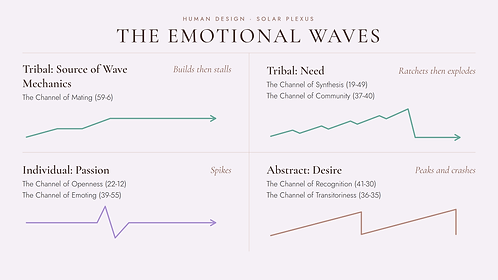
The Solar Plexus holds seven gates, and each belongs to one of the circuits of the body graph. The channel that defines the center determines which wave you carry, and each circuit gives the wave a recognizable shape. The line graph that goes with this post draws them as four lines, because the Tribal circuit holds two distinct waves, while the Individual circuit and the Abstract side of the Collective circuit hold one each.
The Tribal Waves of Intimacy and Need

The Tribal circuit is about support, belonging and the bargains that hold a family or a community together, and both of its waves move in step with those themes.
The Channel of Mating, 59-6, is the source of the emotional wave mechanics. Gate 59 in the Sacral carries the energy to break down barriers and bring people close, and Gate 6, the Gate of Friction, holds the emotional membrane that opens to intimacy or stays closed. On the line graph this wave builds and then levels off, and the long level stretch is a large part of its character. With this channel, a person often needs time to reach clarity about closeness, and there can be a period in which nothing seems to move in either direction.

The second Tribal wave runs through the Channel of Synthesis, 19-49, and the Channel of Community, 37-40. It is often called the need wave, and it moves in small steps. Tension gathers a little at a time while a need for touch, food, support or fair exchange goes unmet, each step settling slightly higher than the last, until the build reaches a point where it releases all at once. The release can look like an outburst out of proportion to whatever set it off, and from the inside it rarely feels sudden, because the build has been going on for days.
Touch matters to this wave in a very physical way. A hand on the shoulder, a shared meal or a promise kept within the family or the team can ease the build long before it reaches the break. Gate 49 holds principles and a readiness to reject what no longer meets them, and Gate 37 holds friendship and the warmth of a fair bargain, so with these channels the wave is closely tied to whether the agreements in a person's life feel honored.
The Individual Wave of Passion and Melancholy

The Individual circuit carries mutation, the new that comes through one person and changes things for others, and its wave has a very different shape. It runs through the Channel of Emoting, 39-55, and the Channel of Openness, 22-12. For long stretches the line stays level, and then it spikes up into passion or drops into melancholy, often with no outer reason for either.
That last part tends to confuse the people who carry this wave, and the people around them. A low comes on a day when everything is going well, and the natural response is to search for a cause, to find the conversation or decision that must have brought it on. Ra Uru Hu was direct that the Individual wave has no cause to find. Melancholy is the chemistry of this circuit, and it carries creative potential: music, writing and new ways of seeing tend to come out of a mood that is allowed to run its course.
Gate 55, the Gate of Spirit, holds the abundance and the emptiness that move through this wave. Gate 22 holds a social grace that opens and closes with mood, which is why timing matters so much for anyone with the Channel of Openness who has something important to say.
The Abstract Wave of Desire and Experience

The Abstract side of the Collective circuit is about experience, living through something and later sharing what it taught so that others can recognize themselves in the story. Its wave runs through the Channel of Recognition, 41-30, and the Channel of Transitoriness, 36-35, and it follows the arc of a desire.
It begins with anticipation. The wave climbs slowly as hope builds around something new, a trip or a relationship or a move to another country, and the expectations grow more detailed the longer the climb lasts. At the peak the experience happens, and then the wave crashes, because the lived version rarely matches the one imagined on the way up. The fall can be sharp, with disappointment or a sense of crisis, and afterwards the wave flattens while the experience is digested.
Gate 30, the Gate of Recognition of Feelings, holds the fire of desire and the pull to feel life fully, and Gate 36 holds the crisis that comes with inexperience. With their partners at the Root and the Throat, they move a person toward experiences whose value shows only in reflection, once the wave has settled and the story can be told. For this wave, the low after the peak is part of how an experience turns into wisdom.
Finding Your Wave in Your Chart
Your chart shows which wave you carry through the channels that connect your Solar Plexus to another center. A defined Channel 59-6, 19-49 or 37-40 gives a Tribal wave. A defined Channel 39-55 or 22-12 gives the Individual wave, and a defined Channel 41-30 or 36-35 gives the Abstract wave.
Some charts define the Solar Plexus through more than one channel, and when those channels belong to different circuits the waves layer over each other. Someone with both 59-6 and 39-55 can know the slow build toward closeness and the sudden drop into melancholy within the same week, and it helps to know that both are running.
An open Solar Plexus amplifies the emotions and feelings of the people around it, often more strongly than they feel them themselves. With time it becomes easier to recognize which feelings belong to someone else and to let them pass through without taking them as your own. I've written more about this side of the center in Support for an Open Emotional System.
What the Wave Means for Decisions
Emotional Authority grows out of this rhythm. A decision made near the top of the wave carries its optimism, one made near the bottom carries its heaviness, and clarity comes from feeling the same question across enough of the wave to see what stays steady. How long that takes depends partly on the shape. The Tribal build can need several days to show its pattern, the Individual wave may stay level for a long time between moods, and the Abstract arc can run as long as the desire itself. I go further into the practice in Emotional Authority in Human Design.
The gates of the Solar Plexus also carry their own nervousness, from the fear of intimacy in Gate 6 to the fear of fate in Gate 30, and these fears tend to rise and settle with the wave. I've written about each of them in Fears of the Solar Plexus.
Any single day on the wave tends to feel like the whole truth of a situation. Looking back over a few weeks usually shows the shape more clearly, and that view can make the next low a little easier to wait through.
A Starting Point
If Human Design is new to you, my free Beginner's Guide is a grounded place to start. If you want to sit with the Gates in your own time, 64 Gates of Human Design Flash Cards in my shop walks through all sixty-four. When you would like to explore your own chart together, Sessions are available to book.


Comments